Category: Patagonia Chile Travel

Patagonia Chile travel guides. Puerto Natales hotels, day hikes without camping, and the Santiago to Patagonia route.

  • Driving in Patagonia (2026 Guide)

    Driving in Patagonia (2026 Guide)

    I thought I was prepared.

    Before you go: install a reliable eSIM for Patagonia’s remote areas so you have maps and messaging when cell signal drops.

    After driving thousands of miles in Chile, I assumed driving in Patagonia would just be “more of the same”. Long roads. Beautiful landscapes. A few potholes. Nothing dramatic.

    I was wrong.

    Driving in Patagonia is not just driving. It is isolation. It is wind that moves your car sideways. It is gravel roads that stretch for hours. It is gas stations that simply do not exist when you expect them.

    And that is exactly why it is unforgettable.

    This is not city driving. Not even close. There are days when you barely see another car. There are stretches where the only thing around you is sky, mountains, and endless emptiness.

    In this guide, I share everything I learned about driving in Patagonia. The surprises, the mistakes, the things that look easy on a map but are not, and what I would absolutely do differently next time.

    This is not a rulebook. It is real experience, from behind the wheel at the end of the world.

    Some basics

    • You drive on the right
    • There are potholes, even on roads that look perfectly fine
    • Bring enough cash for tolls, it adds up quickly
    • Waze is the most used navigation app, not Google Maps, and it shows speed cameras
    • Animals can walk freely on the road, including dogs, sheep, and horses

    What else to know

    • Patagonia is bigger than you think, and it does not care about your schedule
    • The wind can physically move your car across the lane
    • Gas stations are not guaranteed, even when the map says there is a town
    • A paved road can turn into gravel without warning
    • There are stretches where you are completely alone

    Still need to rent a car?

    If you are flying into southern Patagonia, Puerto Natales is one of the easiest places to pick up a rental car. It is the main gateway to Torres del Paine and the surrounding region, and most major routes start from here.

    Renting in Puerto Natales gives you immediate freedom. You can drive straight to Torres del Paine, explore lesser known viewpoints, or plan multi day routes without depending on bus schedules or tours.

    One important thing to check before booking:

    • Is gravel road damage covered?
    • Does the car include a spare tire?
    • Are border crossings to Argentina allowed?
    • How are tolls or park fees handled?
    • Is pickup at the airport or in town?

    RENT A CAR HERE:

    In Patagonia, the car matters more than in cities. Higher ground clearance is often more useful than a flashy vehicle. Reliability beats comfort.

    DiscoverCars is a practical place to compare rental companies in Puerto Natales. You can see real reviews, filter by insurance coverage, and check which vehicles are actually available for your dates.

    If you want flexibility and the ability to stop whenever the landscape pulls you over, renting a car in Puerto Natales is the best way to experience Patagonia on your own terms.

    Things that I found

    • DANGEROUS: headlights are often pointed too high, you will get blinded at night
    • Diesel and gasoline are not cheap, attendants fill up your car and you tip them
    • Driving up mountains requires attention, not every corner has guard rails
    • People will guide you where to park, watch your car for safety, and expect a tip
    • Drivers are aggressive in cities but surprisingly calm on highways
    • There are many crosses next to the road, often because people walk along highways, even at night
    • Toll roads often require cash and the total cost can rise fast
    • Copec gas stations are excellent for quick snacks and unlimited refill drinks
    • Gas stations can be very far apart, especially outside cities, plan ahead to avoid getting stranded
    • When parking, be careful for the dogs that walk around.

    Signage and markings

    All the speed limits are in km/h, NOT in miles/h.

    Gas stations and fuel planning

    This is where many travelers make mistakes.

    Never assume there will be a gas station in the next town.

    In some parts of Patagonia, especially southern Chile and remote Argentina border areas, stations are sparse. Always refill when you reach half a tank if you are heading into remote territory.

    Do not wait until the fuel light turns on.

    Some smaller towns may close early or temporarily run out of fuel. Plan conservatively.

    Parking in Patagonia

    Parking in Patagonia is simple compared to cities.

    In small towns, you park directly along the street. In national parks, parking is often an open gravel area. No marked lines. No attendants. No meters.

    In windy areas, always use the handbrake and park facing into the wind if possible.

    In hiking areas, do not leave valuables visible. While Patagonia feels remote and safe, car break ins can still happen near popular trailheads.

    Road conditions

    Driving in Patagonia means constant change.

    One hour you are on smooth asphalt. The next hour you are on ripio, loose gravel that demands slower speeds and steady control.

    Gravel driving requires:

    • Lower speeds
    • Gentle steering
    • Longer braking distances
    • Patience behind slower vehicles to avoid flying stones

    After heavy rain, potholes become deeper and harder to see. In winter, snow and ice make mountain passes far more challenging.

    Driving at night

    If possible, avoid night driving in Patagonia.

    Street lighting outside towns is almost nonexistent. Animals, especially guanacos and sheep, can suddenly appear on the road.

    Add strong wind and reduced visibility, and night driving becomes stressful very quickly.

    After experiencing crosswinds in daylight, I would never choose to face them in the dark unless absolutely necessary.

  • Patagonia eSIM (2026 Guide)

    Patagonia eSIM (2026 Guide)

    Short answer?
    The best Patagonia eSIM in 2026 is Airalo.

    Connectivity is one booking. The trip shape is in our Patagonia travel guide.


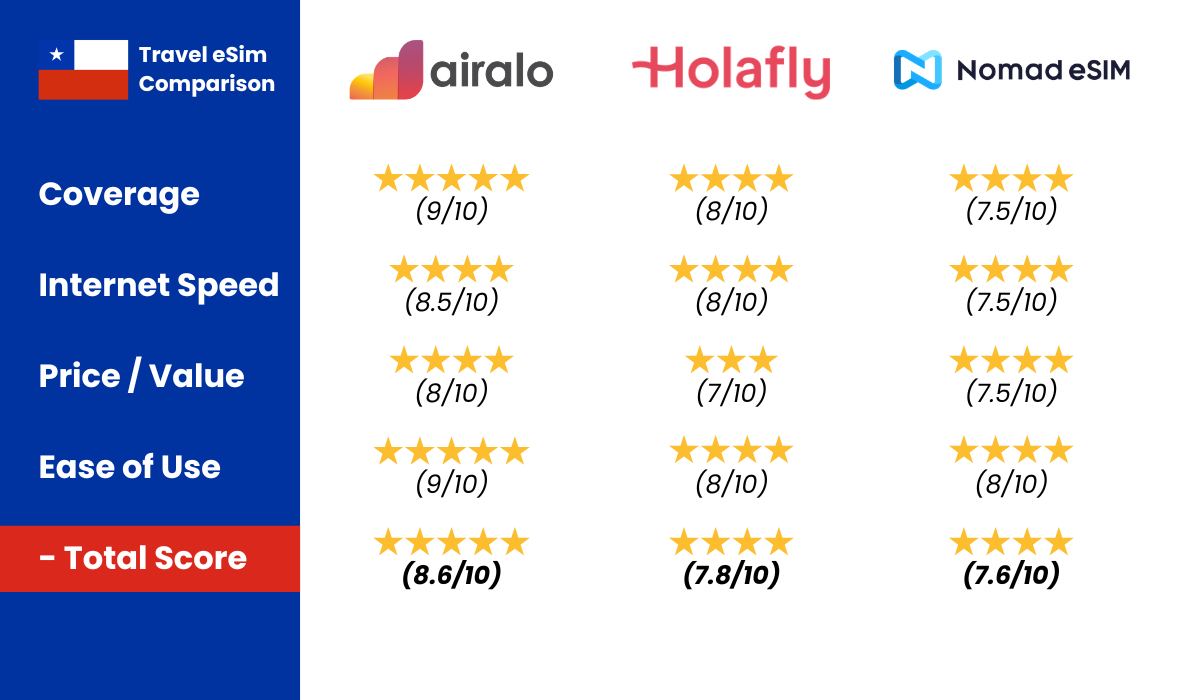
    Chile eSIM comparison: Airalo vs Holafly vs Nomad
    We’ve compared Airalo, Holafly, and Nomad side by side. Click here for our full Chile eSIM comparison.

    For Patagonia you need an eSIM with broad Chile coverage; some remote roads have weak signal even with major providers.

    I’ve tested it myself in Chile and specifically looked into how it performs in Patagonia, because this is where most eSIMs get exposed. Big cities are easy. Patagonia is not.

    New to Airalo? Get $3 off this week with code KJ2068. Download the Airalo App now.

    If you are going to places like:

    • Torres del Paine
    • Puerto Natales
    • El Calafate
    • El Chaltén
    • Carretera Austral
    • Punta Arenas

    You need something reliable.
    🏆 Winner: Airalo
    (I like to cut to the chase). Read more below:

    Why you absolutely need an eSIM in Patagonia

    Patagonia is not Santiago.

    There are:

    • Long empty highways
    • Sudden weather changes
    • Border crossings between Chile and Argentina
    • National parks with limited infrastructure

    And Reddit is full of the same questions:

    “Will I have signal in Torres del Paine?”
    “Does eSIM work on the Carretera Austral?”
    “Should I buy a SIM in Puerto Natales instead?”
    “Is there coverage in El Chaltén?”

    The honest answer?

    You will not have signal everywhere. That is Patagonia.

    But you do want reliable data in:

    • Town centers
    • Airports
    • Bus stations
    • Restaurants
    • Booking accommodations
    • Emergencies

    That is where Airalo performs best.

    Airalo: the best Patagonia eSIM right now

    Airalo connects to major local networks in Chile and Argentina. That matters because smaller eSIM brands often piggyback on weaker partner agreements.

    In real life, here is what that means:

    In towns like Puerto Natales, Punta Arenas, El Calafate, and El Chaltén, coverage is strong and stable.

    Once you go deep into Torres del Paine or remote hiking routes, signal drops. But that happens with literally every provider.

    There is no magical Patagonia eSIM that gives full signal in the mountains.

    Patagonia eSIM coverage

    Let’s be realistic.

    Puerto Natales

    Strong 4G. Works perfectly for maps, bookings, WhatsApp.

    Punta Arenas

    Very solid coverage. Fast speeds.

    El Calafate

    Reliable. No issues for streaming or navigation.

    El Chaltén

    Good inside the town. Limited once you start hiking.

    Torres del Paine National Park

    Signal only near entrances, hotels, or certain lodges.
    Once on the W Trek or O Circuit, assume no service.

    Carretera Austral

    Works in larger villages. Expect long dead zones between towns.

    This is normal for Patagonia. Not an eSIM issue.

    Patagonia eSIM internet speed

    In towns, Airalo feels fast.

    • Google Maps loads instantly
    • Booking apps work smoothly
    • Instagram and YouTube run fine
    • Video calls possible in urban areas

    In remote zones, speed drops before disappearing.

    Again, this is Patagonia infrastructure, not the eSIM provider.

    Chile vs Argentina Patagonia: Do you need two eSIMs?

    Very common Reddit question.

    If you are crossing borders between:

    • Puerto Natales and El Calafate
    • Punta Arenas and Ushuaia
    • Chilean Patagonia and Argentine Patagonia

    You need either:

    • A regional eSIM covering both countries
      OR
    • Two separate country plans

    Airalo offers both Chile-only and Argentina-only options, plus regional packages.

    For most Patagonia travelers doing both sides, the regional plan is easiest.

    No swapping SIMs at border crossings. Just drive through and stay connected.

    Patagonia eSIM prices (2026)

    Airalo plans usually range roughly from:

    • Small data packages for short trips
    • Larger bundles if you use maps constantly

    I personally recommend:

    5GB to 10GB for a 2–3 week Patagonia trip.

    Why?

    Because you will not have signal while hiking. So your actual usage is lower than in city travel.

    Always check the latest pricing on the Airalo website.

    New to Airalo? Get $3 off this week with code KJ2068. Download the Airalo App now.

    One of the things I liked about Airalo is the flexibility. There are plenty of data bundles to choose from, depending on how much you use your phone. As of writing this article, the prices range from about €4.50 for 1 GB up to €42.50 for 20 GB. I personally started with the smaller pack of 10GB and then topped up when I needed more.

    Since prices can change, you can always check the most up-to-date offers directly on the Airalo Chile page.

    How to install your Patagonia eSIM

    Very simple:

    1. Download the Airalo app
    2. Choose Chile, Argentina, or regional South America
    3. Purchase your data package
    4. Follow the installation steps
    5. Activate when you land

    I always install it at home before departure.

    When the plane lands in Punta Arenas or El Calafate, I just turn on mobile data and I am connected instantly.

    No airport SIM hunting.

    Should you buy a local SIM in Patagonia instead?

    Short answer: not worth the hassle.

    In small towns like Puerto Natales or El Chaltén:

    • Shops close early
    • English is limited
    • Lines can be slow
    • Passport registration required

    After a long travel day, the last thing you want is paperwork.

    With Airalo, you are online in minutes.

    Is unlimited data necessary?

    In my opinion, no.

    Unlimited plans sound attractive. But remember:

    Large parts of Patagonia have no coverage anyway.

    You are hiking, driving, exploring.

    You are not binge watching Netflix.

    A solid data bundle is more than enough.

    When Should You Buy Your Patagonia eSIM?

    Buy it 2–3 days before departure.

    Install it at home where you have stable WiFi.

    Then activate once you land.

    Stress-free arrival.

    Is Airalo Really the best Patagonia eSIM?

    For me, yes.

    It gives:

    • Strong town coverage
    • Reliable speed
    • Easy border transitions
    • Simple installation
    • Fair pricing
    • Fast top-ups

    Does it give full signal on a glacier? No.

    Nothing does.

    But for actual travel logistics in Patagonia, it is the most reliable choice right now.

    Final Verdict

    If you want:

    ✔ Easy setup
    ✔ Good coverage in Patagonia towns
    ✔ No airport SIM stress
    ✔ Simple border crossings
    ✔ Reliable travel internet

    Airalo is the best Patagonia eSIM available right now.

    New to Airalo? Get $3 off this week with code KJ2068. Download the Airalo App now.

    You can Download the Airalo app and set everything up in under 5 minutes.

    And once you land in Patagonia, you are already connected. No drama.

    Frequently asked questions

    What should travelers know about Patagonia eSIM?

    For Patagonia you need an eSIM with broad Chile coverage; some remote roads have weak signal even with major providers.

    Quick pick: For most travelers, Airalo is the easiest Chile eSIM to set up before you fly. Compare all providers in our full eSIM comparison, see cheapest Chile eSIM plans, or read region-specific guides for Patagonia eSIM guide.